Long-range passive sonar target tracking in a 2D simulated environment — a novel recurrent neural network that turns per-agent range-amplitude signals into target position and bearing-angle predictions.
What the system does, why it matters, and where it fits.
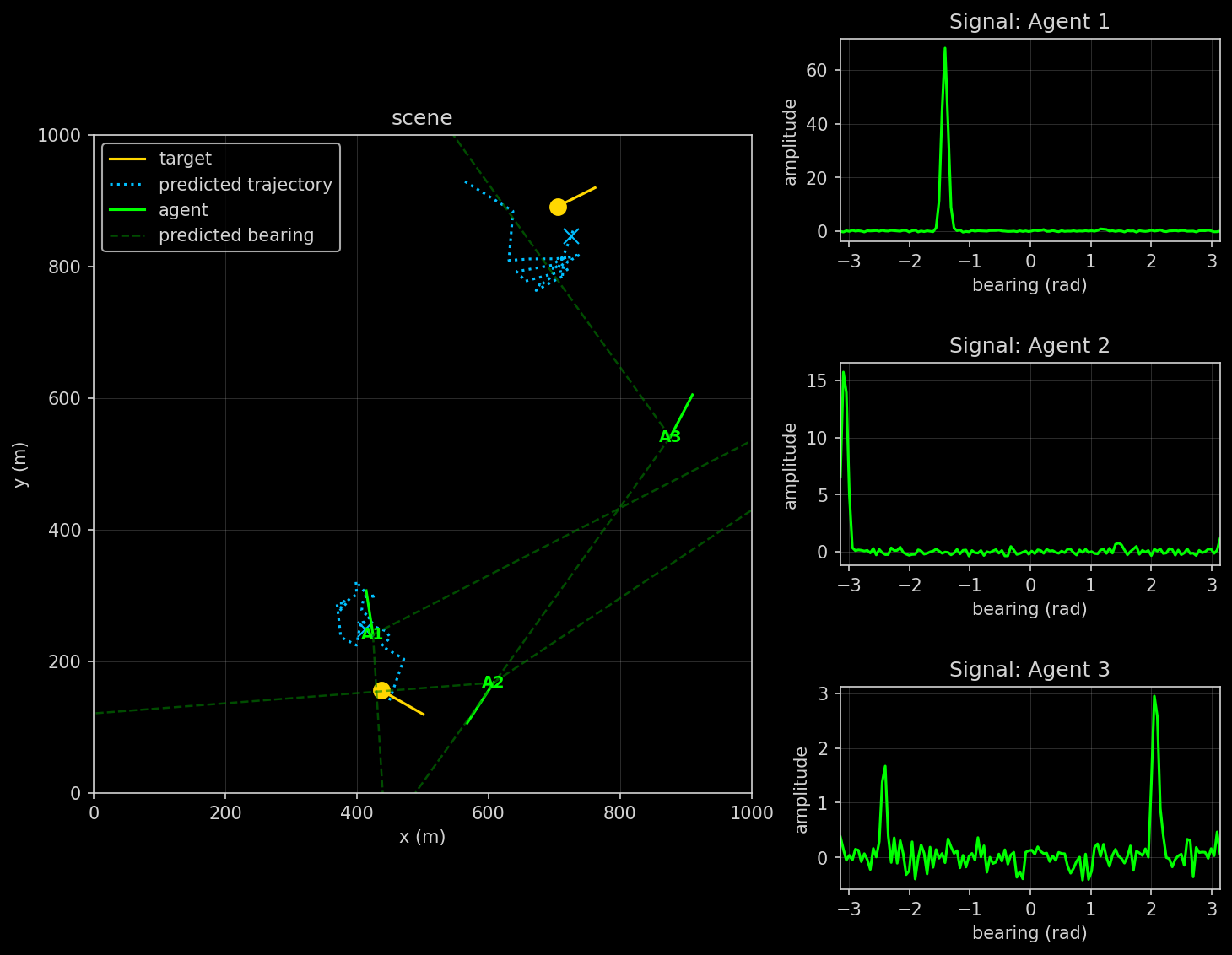
This system performs long-distance passive sonar target tracking in a 2D simulated environment. Any number of cooperating agents each observe a moving target through passive sonar, producing a range-amplitude signal across bearing. A novel recurrent neural network reads those per-agent signals and predicts both the target’s position and its bearing angle.
Because the architecture is recurrent, it performs time-series analysis over the incoming signals: evidence accumulates frame to frame, so tracking confidence improves the longer a target is held. The approach scales to any number of agents and targets, and runs reproducibly on commodity hardware.
Each agent collects a passive range-amplitude signal across bearing — no active emission required.
Signals from every agent are embedded into a representation the network fuses across the array.
A recurrent core integrates observations frame to frame, accumulating evidence as the target is held.
The model outputs target position and bearing angle, with confidence that sharpens over time.
We can walk through the architecture, the simulation, and benchmark numbers under NDA. Send a note and we’ll share what we can.